
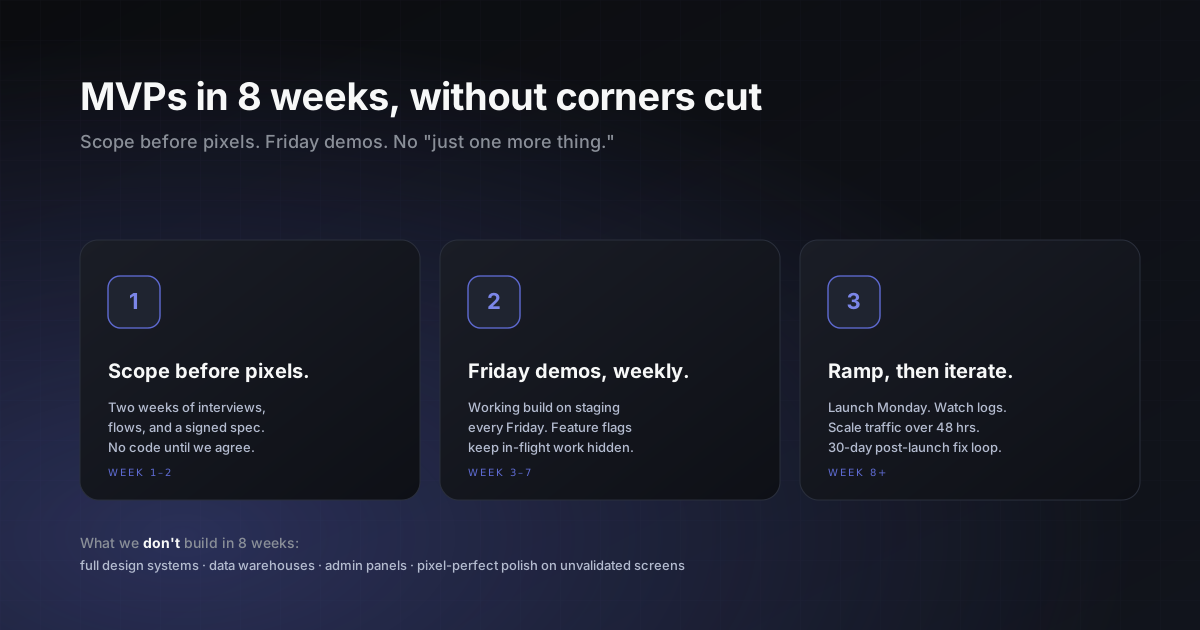
Founders often ask us how we compress a "six-month" MVP build into eight weeks without trading away code quality. The short answer: we do not start from zero. The longer answer is a set of opinionated decisions we make on every engagement — some technical, some process — that cut the slow parts out of a typical build.
Week 1–2: scope before pixels
The most expensive mistake we see founders make is hiring an agency that draws screens before it asks the hard questions. Our first two weeks are purely discovery:
- Stakeholder interviews. Who uses the product, and what are they hired to do?
- Competitive teardown. Which two competitors are one-shotting the problem already?
- Jobs-to-be-done framing for every proposed feature.
- A signed technical spec. What runs on AWS, what runs on Vercel, and what we will not build because the user does not need it yet.
No one writes code in weeks 1 or 2. The design gets validated in a clickable Figma prototype, and nothing ships until the founder and we agree the scope is right.
Week 3–7: weekly demos, no surprises
We run a Friday demo every week. Not a status update — a working build, on staging, that the founder can click through. Everything that ships that week must be behind a feature flag or a staging branch.
The stack is deliberate:
- Next.js App Router with TypeScript — typed end-to-end.
- PostgreSQL on Supabase or RDS — not MongoDB, not Firestore.
- Auth via Clerk or WorkOS — not a hand-rolled session system.
- React Native with Expo for mobile — not native iOS + Android twice.
Those choices shave weeks off the build because they are boring and we have shipped them 50 times. Boring is a feature.
Week 8: launch, then monitor
Week 8 is the first week we touch production. We do not cut over on a Friday. We ship to a small cohort first, watch the logs, then ramp traffic over 48 hours. Every MVP we ship includes:
- Sentry for crash reporting, tuned to filter noise.
- PostHog for product analytics, wired to actual KPIs not vanity metrics.
- A 30-day post-launch retainer where we fix the things real users surface.
That last bullet is non-negotiable. MVPs that ship and then go silent are how startups fail their first investor update.
What we do not do in eight weeks
- Full design systems. We build a scoped set of tokens and components; a real design system is a 12-week engagement.
- Data pipelines. Analytics, yes. A warehouse, no.
- Admin panels. You do not need one yet; a well-scoped Postgres + Metabase gets you to 1,000 users.
If a founder wants one of those in the MVP, we will tell them to push it to v1.1 — or we will not take the engagement. Eight weeks is eight weeks because we are strict about what fits.
If you are thinking about starting
The single biggest predictor of a successful MVP launch, in our experience, is not the stack or the team size — it is how quickly the founder can say no to scope creep. If you can defend a scoped v1, almost any competent studio can ship it in eight weeks.
If you want a second opinion on a spec you have already written, we do one-hour scoping reviews free of charge. Book a call and bring the doc — we will poke holes.